
LOCAL RUBBER ASPAL TRIAL USE TO IMPROVE NATIONAL ABSORPTION
- 05 Des 2017
- News/General
- 1071 viewed
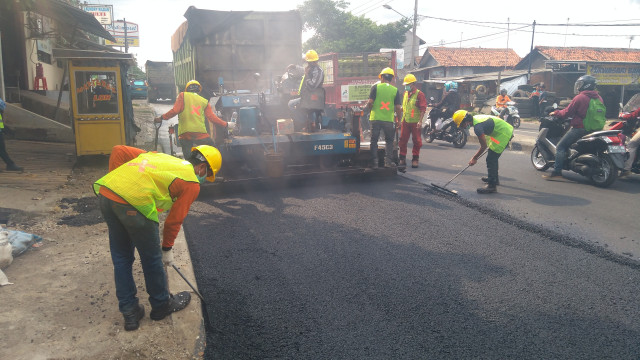
KARAWANG- (BINA MARGA) - Indonesia is one of the three producing countries of natural rubber in Asia, besides Malaysia and Thailand. The use of rubber is very diverse, from industrial needs to road construction. However, the use of domestic rubber for asphalt construction has not yet existed.
Therefore, the National Center for Implementation of National Roads (BBPJN) VI, held a trial of the Crumb Rubber asphalt from local rubber in front of the Purwasari District office, Karawang regency, the Cikampek-Karawang section along 500 meters, on Monday (5/12) yesterday. The Director of Preservation, Directorate General of Highways, the Ministry of Public Works and Public Housing, Hedy Rahadian said that the use of modified rubber asphalt as a form of support from Bina Marga in the Indonesian President's initiative program to boost local rubber commodities.
He said that the price of asphalt in farmers fell by nine times due to reduced world rubber exports. According to the data, national rubber production is 3.15 million tons and 600 thousand tons of which are absorbed by the domestic market and the rest are exported. But lately the amount of rubber exports declined so that domestic rubber prices also declined. "The agreement, Indonesia wants to increase domestic rubber absorption to 800 thousand tons. In 2015 the Ministry of PUPR is committed to absorb 60 thousand tons of natural rubber, "he said.
So the Crumb Rubber asphalt test used in yesterday's trial was an effort of the PUPR ministry in collaboration with the Ministry of Industry to increase local rubber consumption. Hedy added that Bina Marga had already held a trial run on rubberized asphalt. "We have a mission based on national interests. It is against this background in collaboration with the Ministry of Industry and Public Works regarding the use of natural rubber. There is a greater importance, "he said.

Hedy wants the whole utilization of crumb rubber to be properly evaluated so that it can be used in real life in the field and increase the price of natural rubber among farmers. "Please, Balai VI will intensify cooperation with road research and development. this is the new technology, please evaluate it properly, plus and minus, what needs to be improved in the next utilization. Success or failure is a risk, "concluded Hedy.
Met on the same occasion, Head of the National Road Implementing Unit for Region I, West Java, Amri said that rubber asphalt was more resistant to cracking and water. Even so the price per volume is 10-15% more expensive. "Indeed, rubber asphalt is more expensive, but in terms of Wearing Cost thickness which is usually 6 cm can be 3 cm. the price can be competitive. In this trial we use a thickness of 4 cm, "he said.
According to Amri, the use of rubber asphalt is already commonly used but uses rubber from Spain. Its composition in every 9-10% of asphalt levels in it there is 30% rubber. The rubber material is used to coat the material so it is not easily entered by water. Rubber asphalt requires a high temperature but the temperature also cools easily. Amri suggested that it should be used on a section close to the Asphalt Mixing Plant (AMP).
Amri is responsible for 450 km of national roads from Kerawang-Losari, Cirebon-Ciamis and Cirebon-Sumedang. In 2017 there was reconditioning and routine handling with long segment contracts with funds of Rp. 480 billion.
In PJN I West Java there are areas prone to landslides in the areas of Cirebon-Kuningan, Kuningan-Ciamis, Cirebon-Palimanan, Palimanan-Sumedang. "This year there are 7 points of landslide-prone locations that we have handled. "There may still be other landslide-prone locations, but we have coordinated with the planning department to be handled next year," he explained.
It also plans to build 4 suspension bridges in the area of Cirebon to Kuningan. This suspension bridge was built in a rural area to help community mobility. (ian)


