
BBPJN VI TEST TRY METHOD OF SLURRY SEAL TO USE ROAD DAMAGE PREVENTION
- 16 Nov 2017
- News/General
- 841 viewed
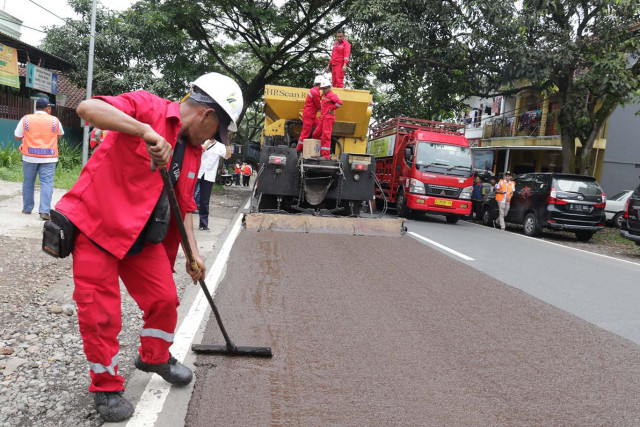
BINA MARGA (CIAMIS) - The handling of road infrastructure is always carried out throughout the year, from the construction of new roads to the maintenance of roads that have been built from damage. On Wednesday (11/15), in the working area of the National Center for Implementing National Roads (BBPJN) VI, precisely in the Ciamis-Batas Jawa Tengah section, trials were being carried out on the asphalt Slury Seal coating as a step to prevent road damage.
Representing the Head of BBPJN VI, Atyanto, Head of Conservation & Equipment Division 2 of BBPJN VI, Edison Rombe said that all halls have been urged to take a preventative approach to road damage compared to periodic maintenance. According to him there are several methods to prevent road damage, one of which is the use of slurry seals.
"So this slurry seal is one of our steps to maintain good road conditions and we are making it so that it can last longer so that we can do efficiency in that place. So this slurry seal is an activity to maintain road conditions, "he said.
This was agreed by the Head of the West Java National Road 2 Work Implementation Unit, Wahyu Budi Wiyono. According to the man who is familiarly called Budi, his party will test the application of slurry seals in three sections within its authority, namely Ciamis-Batas Jateng, Cianjur Circle, and Jampang Kulon -Surade - Tegal Beleud.
According to him the three sections were chosen because they represent three different traffic volumes. "In the trial section this time the traffic is dense, we use type three. The circumference of the traffic cianjur is moderate but we will also use type 3. Later we will see that the conditions are also in the window of a low-traffic kulon. So there are three types of slurry seals for three different volumes of traffic, too, "he concluded.

The use of slurry seals is actually quite common, noted to have been used in the Pantura, Jogja, Bantul and Cilacap lines. While in South West Java, this is the first time, I'm Budi.
Budi said the selection of the slurry seal method had several advantages because it was cheaper and faster to apply than the existing prefentiv method. With Slurry Seal 50-75% lower cost savings than one layer of asphalt. 40-50 thousand per square meter. With a planned age of 1 year.
At the time of the trial, a standard slurry seal model was used which required 3 to 4 hours to complete the opening again. "If you use the quick setting, you can open the traffic in 2 hours. Currently the usual settings are used, "he added.
However, Slurry Seal can only be applied in dry weather conditions and for stable road conditions. "So it's a slurry seal to maintain road stability. if the deformation has already taken place, it needs to be processed first, until we patch the slurry seal on top, "said Budi.
Furthermore, Budi will identify preventive needs in every 2-3 km from 800 km of roads in his working area. The working area is the Nagrek-Batas Jateng segment, West Java South Coast starting from Pangandaran-Cidaun-Jampang Kulon-Pelabuhan Ratu, north to Cianjur-Raja Mandala Boundary, towards Benda in the West.
When met in the same place, the Committing Officer of the Commitment of the Ciamis-Border Area in Central Java and Banjar-Pangandaran, Kadimin asserted that in the segment there was indeed a road with a smoky surface that was loose and / or cracked hair but still in a steady condition (undamaged). "In this trial, we will observe the results, if it is good, next year we will provide slurry seal for the segment with the same conditions so that it will live longer," he said.
According to Kadimin in terms of financing, the use of Slury Seals is much cheaper than maintaining roads with 1 layer of AC toilet. "This preventive program needs to be promoted. Do not asphalt layer for a good road, we are advised to use a preventive program like this slurry seal, "he said.
From Ciamis-Batas Jateng there are about 5 km of roads that have the same conditions. If the results of this trial are satisfactory, 5 km of the road will be given a slurry seal. Meanwhile, the Banjar-Pangandaran section cannot be implemented because the road width is still 6 meters. Hence the application of the slurry seal is prioritized in the main lane which has a width of 7 meters. Because during the process of applying the slurry seal will be applied open and close the road which inevitably causes a long queue of vehicles.
Slurry Seal application does not require many tools, only 1 scan road truck to mix and spread the asphalt slurry. In the truck bed, aggregate material, emulsions, water, cement, and additives are mixed and then spread to the road surface. The process of applying the slurry seal to 500 meters of the road can be done in 30 minutes. Surry seal consists of three types of mixes depending on the damage to the road encountered. The more severe the damage to the pore, the more volume the mortar is used.
The condition of national roads in the PJN 2 region in West Java
After conducting the Slurry Seal trial on the Ciamis-Batas Jateng KM 125 section, the author took the time to talk with the Head of PJN Region 2 West Java, BBPJN VI, Wahyu Budi Wiyono about the condition of the National Road in his area in general.
In the area of Kesatkeran PJN 2 Jabar there are 8 PPK for around 800 km of the National Road which consists of Nagrek-Batas Jateng, West Java South Coast starting from Pangandaran-Cidaun-Jampang Kulon-Pelabuhan Ratu, to the north to Cianjur-Batas Raja Mandala, to Object direction in the West.
According to Budi, there had been a delay in handling the long segment so that there had been 11,000 holes in the road. In addition, there are still many road widths that are not yet standard with 7 meters of National Road, thus producing a bottle neck. Especially in the South Coast of West Java, Pangandaran, Jampang Kulon, Pelabuhan Ratu, and Cibadak. "Whereas the southern region supports tourist routes, ranging from ciwidey, Pangandaran, queen port, and ciletung. Pansela jabar 500 Km. so if you take it takes 1 day 1 night from Pangandaran to the queen port, "said Budi. Even so, Budi is still relieved that road functionality has been achieved.
Another problem is the road avalanche because when it is widened, drainage is not made, such as in the Sukabumi and Cianjur areas. In both areas the community also uses the shoulder of the road to trade so it closes drainage. "We expect support from the local government related to this street vendor. We find it difficult to bring order. if there is a landslide due to lack of drainage, the funds for repairs are also greater, "explained Budi.
In 2017 PJN 2 Jabar was entrusted to manage a budget of Rp. 450 billion used for road widening and reconstruction. 2018 P


